


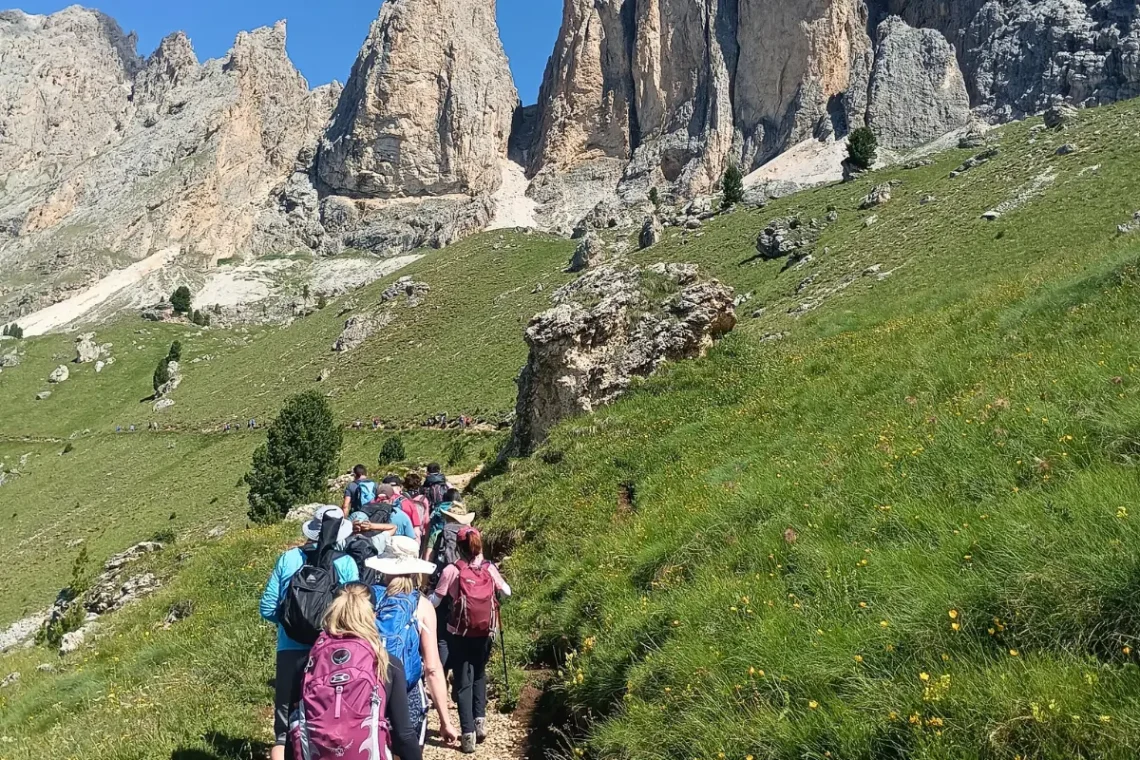
Mountain huts are one of the highlights of hiking in the Italian Dolomites: hot food, sunny terraces facing the Sassolungo and a place to take stock before the descent. This guide focuses on Val Gardena, in the heart of the Dolomites, and lists its huts area by area, with altitude, access and opening periods.
Best Mountain Huts in Val Gardena at a Glance
Val Gardena is home to dozens of mountain huts, alpine restaurants and mountain farms, spread across four areas: the Sassolungo and Sassopiatto group, the Puez-Odle group with the Seceda pastures, the Rasciesa plateau above Ortisei and, just beyond the valley, Alpe di Siusi (Seiser Alm). Some are a few minutes’ walk from a cable car, others take several hours of hiking.
For hikers, the choice depends above all on where the hut sits along the trail. A lunch stop halfway through the hike breaks up the day and leaves enough time for the return. A hut too close to the start, on the other hand, leaves the longest stretch for the afternoon, when summer thunderstorms are more likely.
The table brings together the huts most popular with hikers, with what each one is best for, its altitude, the easiest access and its summer opening period. Dates are indicative: each hut sets them year by year, so check the hut’s website before setting out.
| Mountain hut | Area | Altitude | Easiest access | Best for | Summer opening (approx.) |
| Rifugio Sassopiatto | Sassopiatto | 2,300 m | Friedrich August Trail from Passo Sella | Panoramic hiking and traditional food | Late May to mid-October |
| Rifugio Vicenza | Sassolungo | 2,256 m | From Monte Pana, about 700 m of ascent | A historic hut between Sassolungo and Sassopiatto | June to early October |
| Rifugio Toni Demetz | Forcella del Sassolungo | 2,685 m | From Passo Sella, on foot or by lift | Experienced hikers: the highest hut in the group | Mid-June to late September |
| Rifugio Emilio Comici | Plan de Gralba | 2,153 m | Easy trail from Passo Sella | A more refined lunch | Summer and winter |
| Rifugio Puez | Puez Plateau | 2,475 m | From Passo Gardena or Vallunga | Remote landscapes and challenging hikes | Mid-June to early October |
| Rifugio Firenze | Cisles pastures, Odle | 2,037 m | About 30 minutes from Col Raiser | Easy access and views of the Odle peaks | June to mid-October |
| Rifugio Juac | Above Selva | 1,905 m | About one hour from Selva | A short climb from the village | June to mid-October, also in winter |
| Rifugio Stevia | Stevia pastures | 2,312 m | From Selva via Juac, about 2.5 hours | Challenging hikes and quieter trails | July to mid-September |
| Almhotel Col Raiser | Col Raiser | 2,106 m | Cable car from Santa Cristina | No hiking needed: right at the cable car | Summer and winter |
| Rifugio Resciesa | Rasciesa | 2,165 m | Funicular from Ortisei, then 20 minutes | Easy panoramic walks | Summer |
| Rifugio Molignon | Alpe di Siusi | 2,054 m | About 6 km across the plateau | Alpine meadows and gentle walks | Late May to mid-October |
Rifugio, Baita and Malga: What’s the Difference?
A rifugio is a high-altitude mountain hut offering food and overnight accommodation, often run for the Italian Alpine Club (CAI) or the South Tyrolean Alpine Club (AVS). A baita, called ütia in the local Ladin language, is a smaller mountain restaurant that usually serves only during the day. A malga was originally a summer alpine farm, where livestock grazed and milk, butter and cheese were made.
In practice the lines are blurred. Many malghe now have a proper kitchen, some baite rent a few rooms and several rifugi are a short walk from a cable car. For a lunch stop the label matters little: what matters is that the hut is open, that the kitchen is serving at the right time and that it lies on your route.
Sassolungo and Sassopiatto: Huts at the Foot of Val Gardena’s Landmark
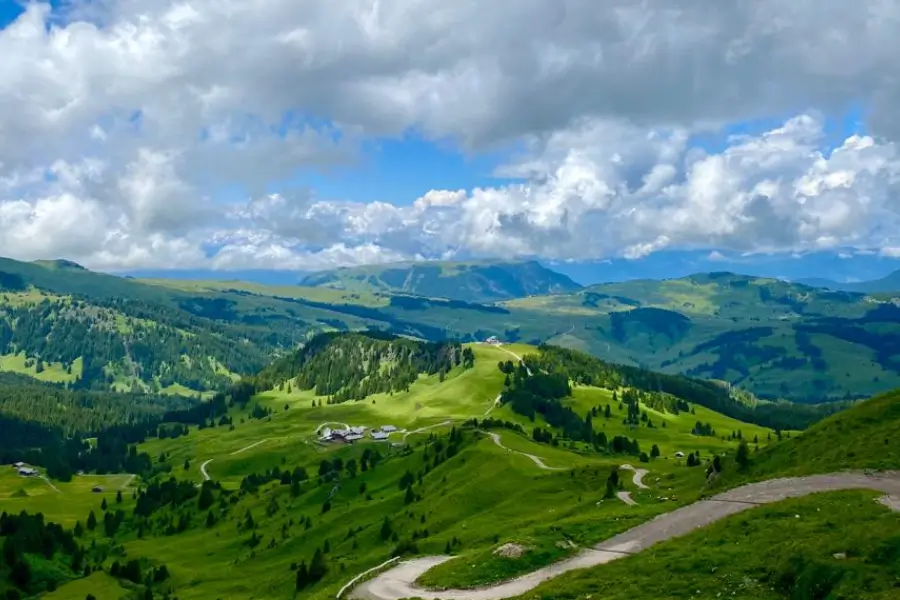
The Sassolungo group has some of the busiest huts in Val Gardena, because the full circuit of the massif and the Friedrich August Trail (Sentiero Federico Augusto) are among the most popular routes in the Dolomites. Huts stand on both sides of the massif, so the lunch stop can follow your direction of travel.
Rifugio Sassopiatto, at about 2,300 meters, lies on the Friedrich August Trail, a panoramic route at the foot of Sassolungo and Sassopiatto with open views of Alpe di Siusi and the Sciliar. It is the classic stop on the southern side of the massif. The trail is wide and well marked, with moderate ups and downs, so lunch comes halfway through the day without a hard descent afterwards. In July and August the terrace fills up early: arriving before noon is advisable.
The full Sassolungo circuit is longer, with some more exposed sections. Here the huts are also reference points in bad weather. On the northern side, toward the Città dei Sassi (City of Stones) and Passo Sella, several huts close together let you adapt the stop to the group’s pace and the sky.
Rifugio Vicenza, Toni Demetz and Emilio Comici
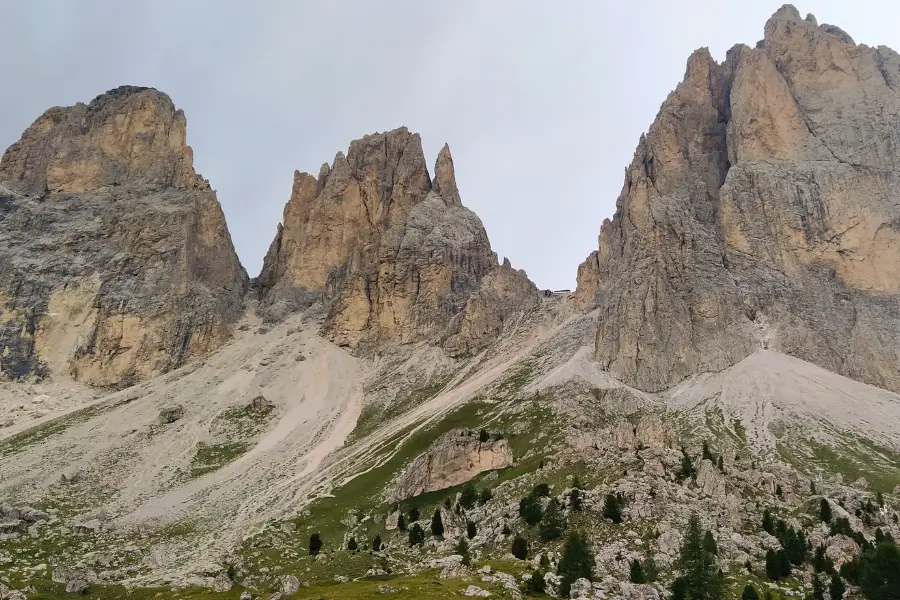
Rifugio Vicenza, at 2,256 meters, stands in the rocky basin between Sassolungo and Sassopiatto and is one of the valley’s historic huts. It can be reached from Monte Pana with about 700 meters of ascent, or by descending from Forcella del Sassolungo. The kitchen is traditional, and canederli (Knödel), South Tyrolean bread dumplings, are among the most popular dishes.
Rifugio Toni Demetz, at 2,685 meters, is the highest hut in the group and sits right on Forcella del Sassolungo. From Passo Sella it takes about an hour and a half on foot, or the lift when it is running. The trail is steep: it calls for proper mountain boots and experience on rocky terrain.
Rifugio Emilio Comici, at 2,153 meters near Plan de Gralba, is more of a food destination. It is known for cooking that combines alpine traditions with seafood, it also opens in winter and booking is recommended at busy times.
Puez-Odle: Rifugio Puez, Firenze, Juac and Stevia
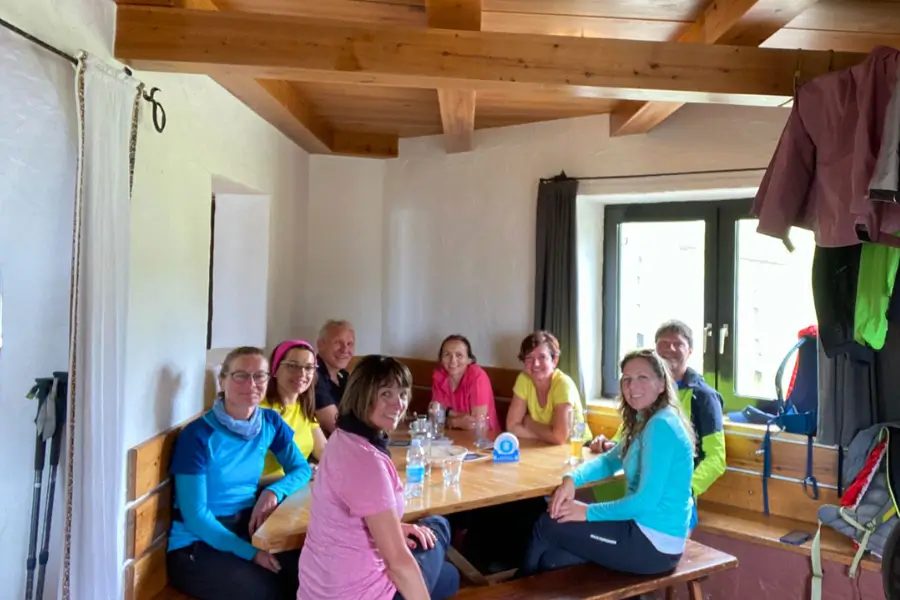
The Puez-Odle Nature Park, part of the Dolomites UNESCO World Heritage Site, covers the northern side of Val Gardena and holds the valley’s most remote huts. Lifts help less here, so a hut stop is often a necessity as well as a pleasure.
Rifugio Puez, at 2,475 meters, stands in the middle of the Puez Plateau, a landscape of rock and scree that looks almost lunar. It can be reached from Passo Gardena or by climbing up from Vallunga, near Selva, and it is also a stage of the Alta Via 2, with beds for trekkers crossing the group over several days.
For many hikers lunch at the Puez is an essential break before the long descent toward Selva. Between the plateau and the floor of Vallunga the drop is over 1,000 meters, and reaching the hut with energy to spare makes the difference on the way down. Hikers not used to long descents should assess this route carefully.
On the western side of the park, Rifugio Firenze (Regensburger Hütte) is one of the oldest huts in the valley. It was built in 1888 by the Regensburg section of the German and Austrian Alpine Club, hence its German name. It stands at 2,037 meters on the Cisles pastures, below the Odle peaks, about 30 minutes on foot from Col Raiser.
Above Selva are Rifugio Juac, at 1,905 meters, and Rifugio Stevia, at 2,312 meters, linked by a panoramic trail. The climb from Selva to the Stevia via Juac takes about two and a half hours with 850 meters of ascent: a demanding hike, far less crowded than the areas served by lifts.
Seceda and Col Raiser: Fermeda, Col Raiser and Sëurasas
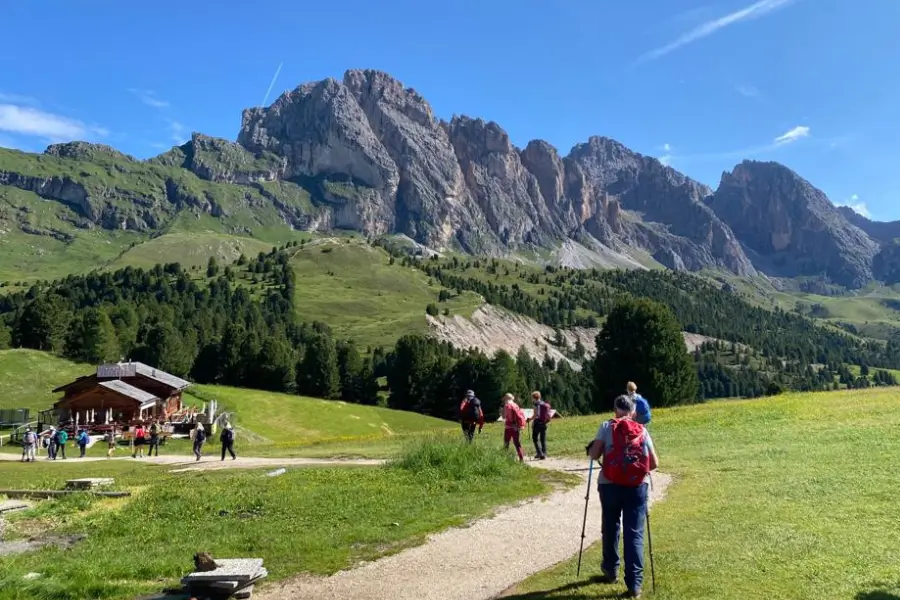
Between Santa Cristina and the Seceda lies a plateau of meadows and farms reached by the Col Raiser cable car. At the top station, at 2,106 meters, Almhotel Col Raiser offers food and rooms. About 30 minutes on a nearly level path lead to Rifugio Fermeda, with views of Sassolungo and Sassopiatto.
From Col Raiser, trails lead to Rifugio Firenze, Monte Pic and the Seceda, with several huts along the way, including Baita Troier and Baita Sofie. A little farther south, below Monte Pic, Malga Sëurasas is a family-run hut surrounded by pastures. Its Ladin name means “above the rock”, and its setting explains why this pasture is one of the best-loved viewpoints in the valley.
Rasciesa: Mountain Huts Above Ortisei
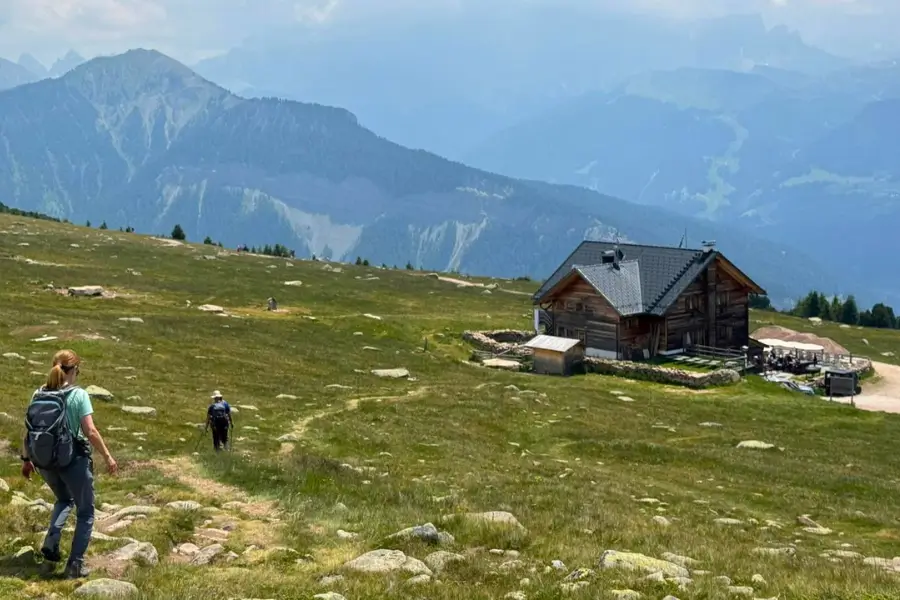
Rasciesa (Raschötz) is the plateau above Ortisei on the northern side of the valley, inside the Puez-Odle Nature Park. A funicular from the village climbs to about 2,100 meters, where easy trails open up with views of Sassolungo, the Sciliar and, to the north, Val di Funes.
Rifugio Resciesa, at 2,165 meters, is about 20 minutes from the top station along a nearly level path. Its terrace faces the Sassolungo group and the kitchen serves traditional dishes such as Schlutzkrapfen, half-moon pasta filled with spinach and served with melted butter. From the hut, a few minutes’ climb leads to the Santa Croce chapel and the summit of Rasciesa di Fuori, at 2,281 meters.
For a longer walk, continue to Malga Brogles, at 2,045 meters, on open pastures below the northern face of the Odle. It is about an hour and twenty minutes from the top station: a quieter lunch stop, away from the busiest spots.
Rasciesa is also the first hiking day of Dolomiti Experience, WeHike’s trip in Val Gardena: a panoramic loop with lunch in the mountains and a return to Santa Cristina in the afternoon. The day-by-day program is on the Dolomiti Experience itinerary page.
Alpe di Siusi: Huts and Farms on the Plateau
Alpe di Siusi (Seiser Alm) is the largest high-altitude alpine pasture in Europe and borders Val Gardena to the south. A cable car connects it to Ortisei, and the plateau offers a dense network of easy trails across meadows, scattered woods and farms.
The choice of stops is huge. Among the best known is Rifugio Molignon, at 2,054 meters, reached with about 6 kilometers of walking and 400 meters of ascent. Higher up, toward the Sciliar and Catinaccio ranges, are Rifugio Alpe di Tires, at 2,440 meters, and Rifugio Bolzano at Monte Pez, at 2,457 meters.
Coming from Val Gardena, Alpe di Siusi suits a more relaxed day, with gentle gradients and wide views of Sassolungo and the Sciliar. Its farms vary a lot, from small working farms serving cheese platters and fresh milk to full mountain restaurants with terraces. Private traffic on the plateau is restricted during the day, so the cable car from Ortisei is the easiest way to arrive and start walking.
What to Eat in the Mountain Huts of the Dolomites
Huts in Val Gardena bring together three cuisines: Ladin, rooted in the valley’s traditions, South Tyrolean and Italian. The result is a hearty menu, made for people who have walked all morning and still have the return ahead.
The most common dish is canederli (Knödel), large bread dumplings served in broth, with melted butter or with cabbage salad. Alongside them you will find Schlutzkrapfen, goulash soup, polenta with sausage and mushrooms, and platters of speck and alpine cheeses.
Among desserts, apple strudel and Kaiserschmarrn, a shredded sweet pancake served with lingonberry jam, are the classics. The valley’s most typical sweet, though, is crafons, similar to doughnuts and filled with poppy seeds, honey and cinnamon. Many huts also offer vegetarian dishes and gluten-free or lactose-free options, marked on the menu.
On a hiking day, choose a filling but not heavy dish, such as a soup or a plate of canederli, and save dessert for later. A big meal followed by a steep climb is one of the most common mistakes in the mountains. The same goes for drinks: water and hot tea help more than a beer when several hours of trail are still ahead.
Opening Hours, Payments and Reservations
The hot kitchen in huts keeps its own hours, often shorter than the hut’s opening hours, and usually runs from late morning to early afternoon. Arriving late may mean only drinks, cakes and cold dishes.
Lunch reservations are usually not needed at traditional rifugi, while they are recommended at the most sought-after places, such as the Comici. Dinner and an overnight stay should always be booked in advance. Many huts accept cards, but in remote areas the connection can fail: carrying some cash avoids surprises. Groups should order together on arrival: on busy days the kitchen works flat out and waiting times can eat into the time left for the descent.
Practical Tips for Visiting Mountain Huts in the Dolomites
Two precautions are worth adding to the advice above, especially early and late in the season.
- Bring the essentials even if you plan to eat at a hut: enough water, waterproof layers and some snacks. A hut can occasionally be closed without notice.
- Check for snow early in the summer: in June some trails at higher altitudes may still hold snow, even when the huts nearby are already open.
When Do Mountain Huts Open in Val Gardena?
The summer season for huts runs from late May to mid-October, with differences linked to altitude and location. Huts lower down or close to lifts open earlier and close later, while the highest ones, such as Toni Demetz or Stevia, have shorter seasons.
Almost all huts are open from early July to mid-September. July and August are also the busiest months: the terraces of the best-known huts fill up before noon and the parking areas at the lifts fill early. In high summer, also consider the afternoon weather: heat storms often build after 2 pm and move in quickly at altitude. Planning lunch halfway through the hike, not at the end, leaves time to get back before the weather turns.
June and September are a good compromise. In June the meadows are in flower and some shaded gullies may still hold snow; in September the light is softer, temperatures cooler and the trails quieter. In both months, check the opening dates on each hut’s website. Some huts, such as the Comici, Juac and Almhotel Col Raiser, also open in winter, when they serve skiers and snowshoers.
Five Mountain Hut Lunches in One Week in Val Gardena
The easiest way to get to know the huts of Val Gardena is to hike for several days, changing area each morning and returning each evening to the same hotel. That is the idea behind Dolomiti Experience, WeHike’s trip in Val Gardena: seven days based in a 4-star hotel with a spa in Santa Cristina and five days of hiking led by two qualified hiking guides. Each day includes a lunch stop in the mountains:
- Rasciesa: a panoramic loop above Ortisei, with views of Sassolungo.
- Sassolungo and Sassopiatto: the Friedrich August Trail, with lunch at Rifugio Sassopiatto.
- Monte Pic and Sëurasas: a climb through quiet alpine pastures.
- Puez Plateau: the most demanding day, with lunch at Rifugio Puez and the descent through Vallunga.
- Alpe di Siusi: an easier day across Europe’s largest high-altitude pasture.
Hut lunches are not included in the price, which covers half board at the hotel: everyone chooses their dishes and pays at the hut. In return there is no heavy pack to carry and no lifts or return times to work out, because the guides take care of that.
For the atmosphere of the trip, read about a week of group hiking in Val Gardena; the guide to the best hikes in Val Gardena describes the five trails stage by stage.
Departures are in June and September, the two months that combine open huts and quieter trails. Dates and availability are on the Dolomiti Experience departures page, along with WeHike’s other hiking trips in the Dolomites.
Frequently Asked Questions About Mountain Huts in Val Gardena
What are the most famous mountain huts in Val Gardena?
Among the best-known huts in Val Gardena are Rifugio Puez on the Puez Plateau, Rifugio Firenze below the Odle peaks, Rifugio Vicenza and Rifugio Sassopiatto in the Sassolungo group, the Comici near Plan de Gralba and Rifugio Stevia above Selva. All are classic lunch stops on a summer hike in the Dolomites.
When do mountain huts in Val Gardena open for the summer?
Most huts in Val Gardena open between late May and mid-June and close between late September and mid-October. Higher huts have shorter seasons: Rifugio Stevia, for example, opens in July. Dates change every year, so always check them on the website of each hut before setting out.
What is the difference between a rifugio, a baita and a malga?
A rifugio is a high-altitude hut offering meals and beds. A baita, ütia in Ladin, is a smaller mountain restaurant usually open only during the day. A malga is a summer alpine farm where livestock graze and cheese is made; many now also serve meals to hikers.
Do you need to book lunch at mountain huts in the Dolomites?
At traditional rifugi lunch is usually not booked: you arrive, find a seat and order. At the most sought-after places, such as Rifugio Emilio Comici, booking is recommended, especially in high season. Dinner and overnight stays should always be booked in advance, directly with the hut.
Which mountain huts in Val Gardena can you reach without a difficult hike?
Several huts are a short walk from the lifts. Rifugio Resciesa is about 20 minutes from the Ortisei funicular, Almhotel Col Raiser sits at the top of the cable car, and Rifugio Fermeda and Rifugio Firenze are about 30 minutes from Col Raiser on easy paths. Wear proper footwear all the same.
What food should you try in Dolomites mountain huts?
Huts in Val Gardena mix Ladin, South Tyrolean and Italian cooking. The most common dishes are canederli (bread dumplings), Schlutzkrapfen (filled half-moon pasta), goulash soup, polenta with sausage and platters of speck and cheese. For dessert, try apple strudel, Kaiserschmarrn and crafons, the valley’s poppy-seed doughnuts.
Is June or September better for hiking in Val Gardena?
Both work well. June brings flowering meadows and long days, but snow may linger on higher trails. September is cooler and quieter, with softer light. Either way, check that the huts and lifts you need are open: some higher huts, such as Rifugio Stevia, open only in July.