


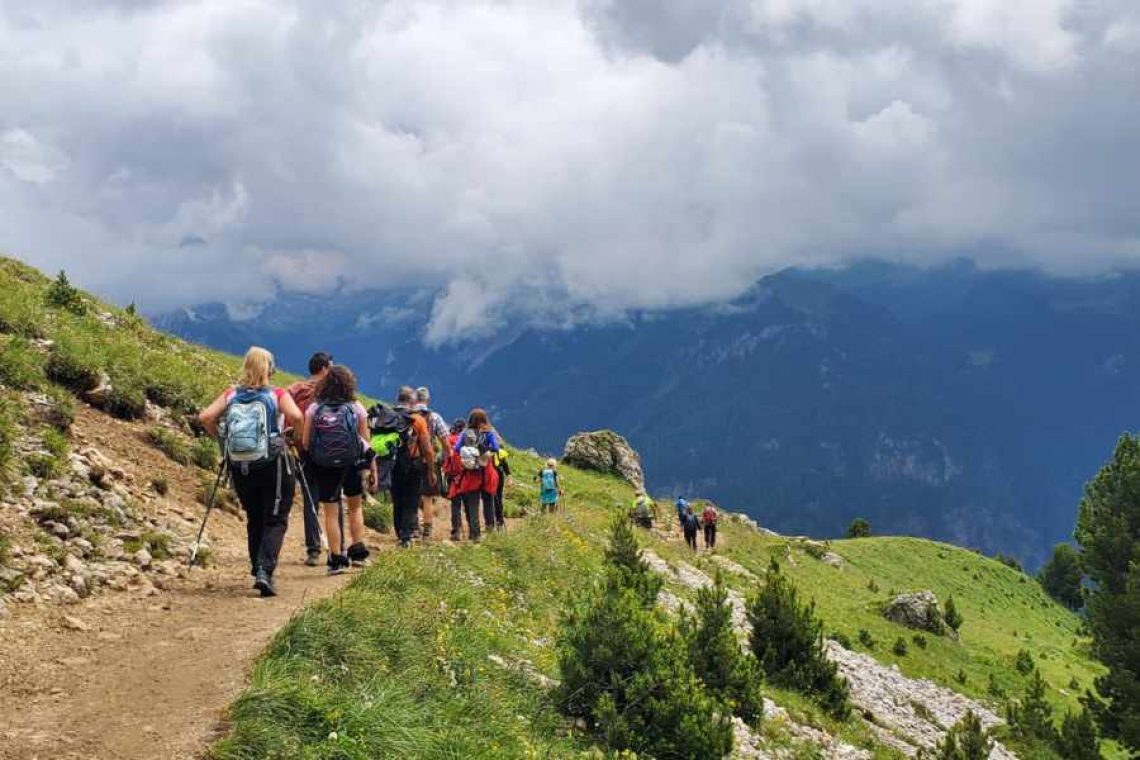
If you are planning a hiking trip in the Italian Dolomites, Val Gardena is one of the best areas to explore on foot. Five carefully chosen hikes are enough to experience many of the landscapes that make the Dolomites so extraordinary: the Alpine meadows of Resciesa, the dramatic Sassolungo and Sassopiatto mountains, panoramic Monte Pic, the rocky Puez Plateau and the wide-open pastures of Alpe di Siusi.
These are also the five hiking days included in WeHike’s guided hiking trip in the Dolomites, designed as a one-week, hotel-based hiking vacation with a different trail to explore each day.
5 of the Best Hikes in the Dolomites: Val Gardena at a Glance
Together, these five hiking trails showcase remarkably different sides of the Italian Dolomites: Alpine meadows, rugged limestone mountains, panoramic summits, high-altitude plateaus and traditional mountain pastures.
Distances range from approximately 9 to 15 km (5.6–9.3 miles), with elevation gains ranging from about 300 to 1,000 meters (985–3,280 feet).
By “high-altitude day hike,” we mean a hike that often begins with a cable car or funicular and returns to the valley later in the day. Using mountain lifts eliminates some of the steepest approaches and gives hikers more time to walk where the scenery really opens up.
The order of these five hikes is intentional. Moderate hiking days alternate with more demanding routes, allowing the body to gradually adjust to the elevation before tackling the Puez Plateau, the most strenuous day of the week.
This gradual progression makes the itinerary ideal for regular hikers who want to experience several of the best hiking trails in the Dolomites without taking on a hut-to-hut trek.
| Trail | Area & Access | Distance | Elevation Gain | Lunch Stop | Effort |
| Resciesa | Ortisei, Resciesa funicular | 12 km / 7.5 mi | 500 m / 1,640 ft | Mountain hut | Moderate |
| Sassolungo & Sassopiatto | Friedrich August Trail | 15 km / 9.3 mi | 550 m / 1,805 ft | Rifugio Sassopiatto | Moderate |
| Monte Pic & Alpe Sëurasas | Santa Cristina, Col Raiser lifts | 9 km / 5.6 mi | 330 m / 1,080 ft | Mountain hut | Moderate |
| Puez Plateau & Vallunga | High-altitude traverse to Selva | 15 km / 9.3 mi | 1,000 m / 3,280 ft | Rifugio Puez | Most demanding |
| Alpe di Siusi | High plateau above the valley | 9 km / 5.6 mi | 300 m / 985 ft | Mountain hut | Most relaxed |
Actual hiking times depend on the pace of the group, weather, trail conditions and stops. With time for photos and lunch at a mountain hut, each hike takes up most of the day, with a return to the hotel in the late afternoon.
Resciesa: Alpine Meadows Above Ortisei
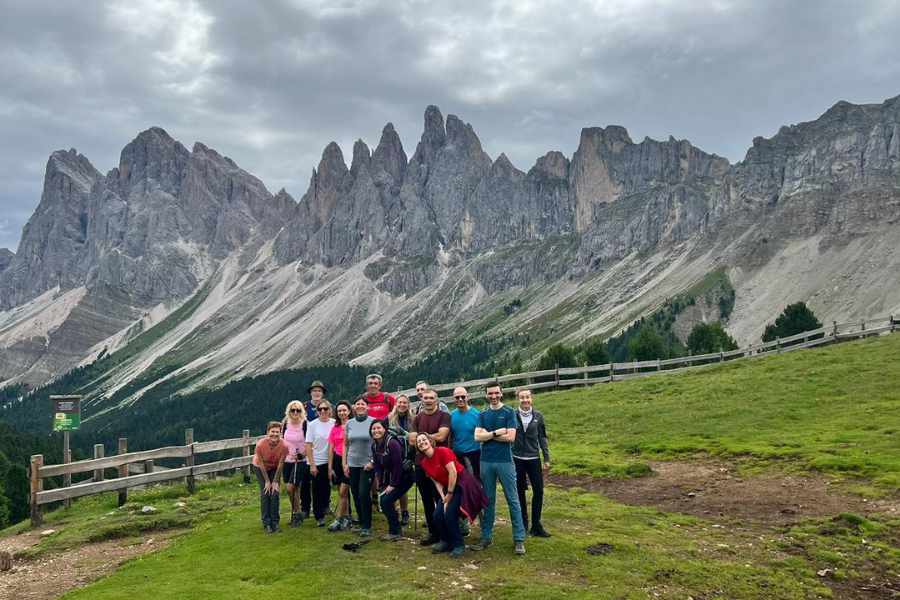
Resciesa is an excellent first hike for travelers discovering the Italian Dolomites. Our route covers approximately 12 km (7.5 miles) with about 500 meters (1,640 feet) of elevation gain across the Alpine meadows above Ortisei, within the Puez-Odle Nature Park.
The first part of the ascent is covered by the Resciesa funicular, so most of the hiking takes place at altitude rather than on a long, steep climb from the valley.
From the upper station, trails cross open pastures, wooden mountain huts and short stretches of woodland. The real highlight is the panorama: the Odle peaks, Sassolungo and the mountains surrounding Val Gardena create a much broader perspective than you can experience from the valley floor.
For travelers looking for hikes from Ortisei, Resciesa is particularly convenient. The funicular leaves directly from town, the trail network is well marked and mountain huts along the route make it easy to stop for lunch.
It is also a good hike for becoming comfortable with the altitude without overdoing it on the first day.
In the WeHike itinerary, Resciesa is our first hiking day. After the arrival day, this moderate trail allows the guides to understand the pace and fitness level of the group before the longer hikes later in the week.
Anyone hiking independently should check the operating hours of the Resciesa funicular before setting out, since the final ride back to Ortisei determines how late you can remain on the plateau.
Sassolungo and Sassopiatto on the Friedrich August Trail
The hike below Sassolungo and Sassopiatto follows the panoramic Friedrich August Trail, known in Italian as the Sentiero Federico Augusto.
Our route covers approximately 15 km (9.3 miles), with about 550 meters (1,805 feet) of elevation gain and a lunch stop at Rifugio Sassopiatto, at roughly 2,300 meters (7,550 feet).
At 3,181 meters, Sassolungo is one of the unmistakable landmarks of the Italian Dolomites and one of the most recognizable mountains in Val Gardena.
The Friedrich August Trail runs beneath the imposing walls of the Sassolungo and Sassopiatto groups, following a panoramic mountain route with gradual climbs and long traverses.
This itinerary should not be confused with the complete Sassolungo circuit, which follows a different and more demanding route.
For a guided group trip, the Friedrich August Trail offers an excellent balance: spectacular Dolomites hiking scenery without requiring everyone in the group to tackle the more challenging full circuit.
The stop at Rifugio Sassopiatto is one of the highlights of the week.
From the area around the hut, the landscape opens toward the Alpe di Siusi, which we explore later in the itinerary. Seeing the plateau from above also helps you understand how the different hiking areas of the week connect geographically.
If possible, start early. The trails beneath Sassolungo are among the most popular in Val Gardena during July and August, while June and September generally offer a quieter hiking experience.
Monte Pic and Alpe Sëurasas from Col Raiser
The Monte Pic hike is one of the shorter days in our Dolomites hiking itinerary, but it delivers one of the widest panoramas of the entire week.
Our route is approximately 9 km (5.6 miles), with about 330 meters (1,080 feet) of elevation gain, reaching Monte Pic at around 2,364 meters (7,756 feet).
We use the Col Raiser gondola from Santa Cristina to reach the Alpine meadows below the Odle mountains. From here, the trail crosses high pastures before heading toward Monte Pic and the beautiful Alpe Sëurasas.
Monte Pic’s central position offers an exceptional 360-degree panorama. From the summit area you can identify Sassolungo, the Sella group, the Odle peaks and Alpe di Siusi—in other words, many of the landscapes explored during the rest of the week.
Lunch is taken at a mountain hut along the route.
There is another reason for placing this shorter hike before Puez: it gives the group a chance to recover some energy before the most demanding hiking day, without giving up one of the finest viewpoints in the Dolomites.
Travelers who would rather explore these mountains with professional guides and without having to organize lifts, transportation and daily logistics can check the upcoming June and September departures of WeHike’s guided hiking trips in the Dolomites.
Puez Plateau and Vallunga: The Most Challenging Hike
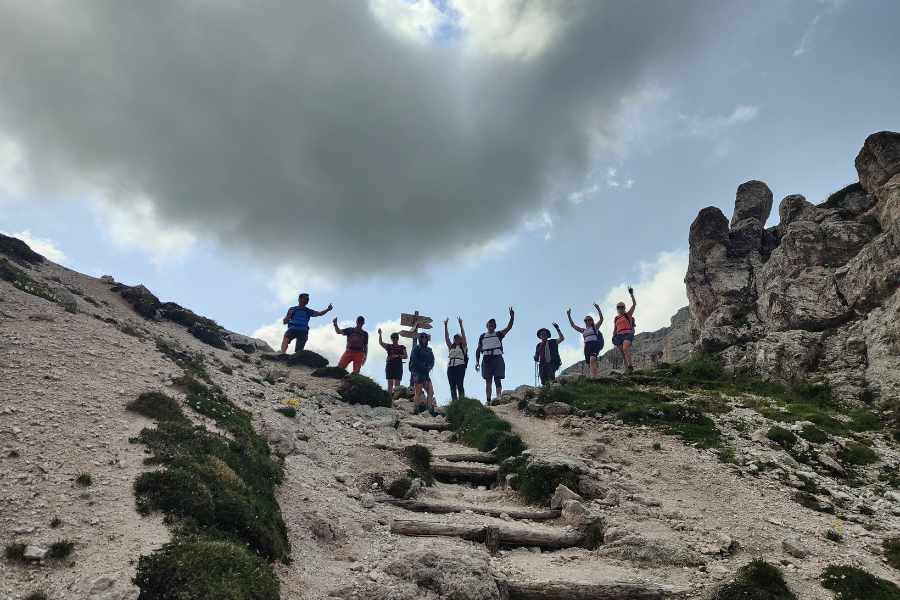
The traverse across the Puez Plateau is the most demanding hiking day of the itinerary: approximately 15 km (9.3 miles), around 1,000 meters (3,280 feet) of elevation gain, a stop at Rifugio Puez at 2,475 meters (8,120 feet), and a long descent through Vallunga to Selva di Val Gardena.
Good hiking fitness and a steady pace are important.
The Puez Plateau lies within the Puez-Odle Nature Park, part of the UNESCO World Heritage Dolomites. The landscape is dramatically different from the green Alpine meadows of the other hikes: pale rock, sparse vegetation and broad open spaces give the plateau an almost lunar appearance.
The geology is one of the most fascinating aspects of the day. The Dolomites preserve extraordinary evidence of ancient marine environments and reef formations, and the rock layers are particularly visible in the Puez area.
Rifugio Puez, at the heart of the plateau, provides an important lunch break before the long descent.
From here, the hike eventually enters Vallunga, a striking glacial valley enclosed by towering Dolomite walls, before reaching Selva di Val Gardena.
The descent is long and can be particularly demanding on the knees.
For visitors looking for an easier hike from Selva di Val Gardena, Vallunga can also be explored independently as a gentler valley walk. In our full itinerary, however, it forms the final section of one of the most rewarding traverses of the week.
Trekking poles, sufficient water and a careful check of the mountain weather forecast are particularly important on this day. If storms or unsafe conditions are expected, the guides can modify the route for the safety of the group.
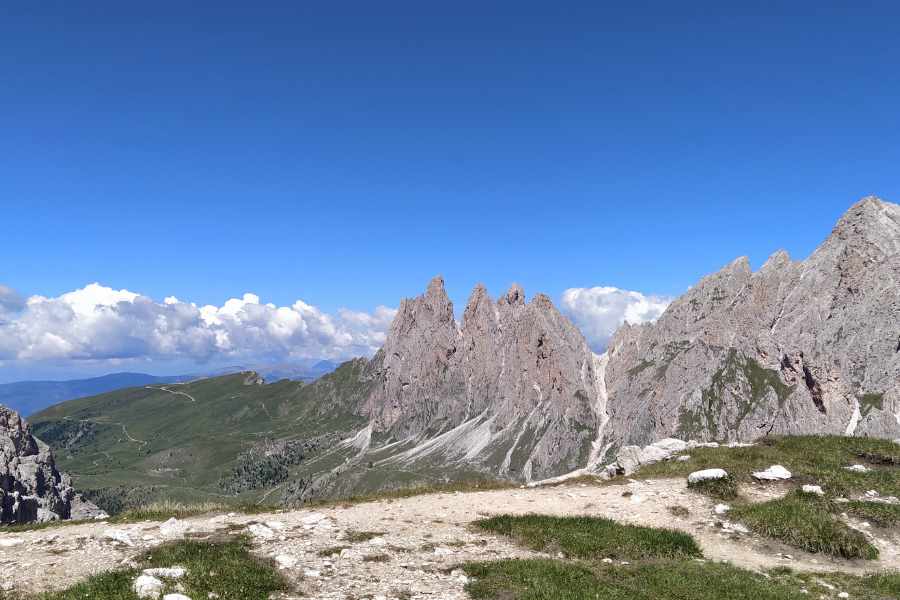
Alpe di Siusi: Hiking Across Europe’s Largest High Alpine Pasture
Alpe di Siusi (Seiser Alm) brings the week to a gentler conclusion and offers one of the classic landscapes of a hiking vacation in the Italian Dolomites.
Our itinerary covers approximately 9 km (5.6 miles) with about 300 meters (985 feet) of elevation gain, crossing high-altitude meadows with views toward Sassolungo, Sassopiatto and the distinctive Sciliar massif.
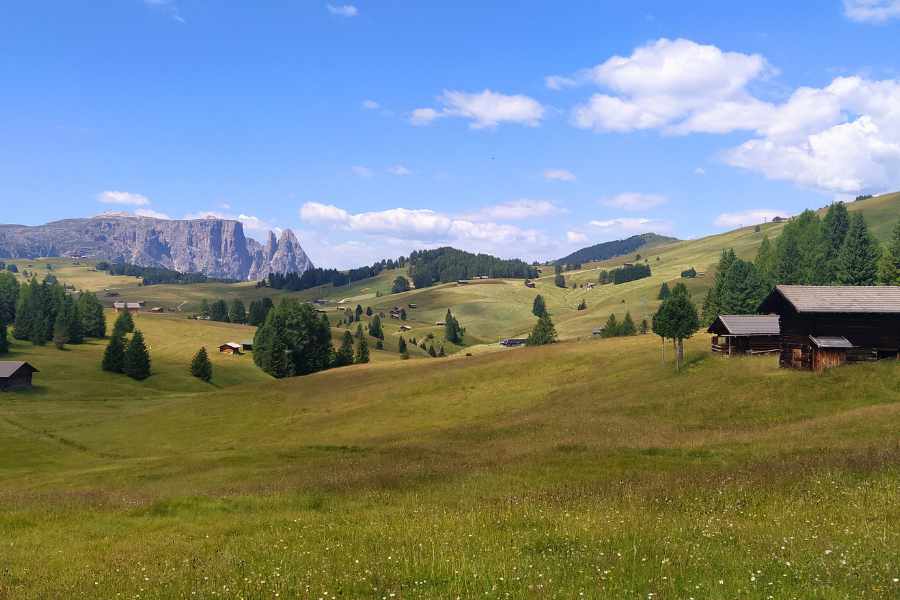
Alpe di Siusi is the largest high Alpine pasture in Europe and offers an extensive network of hiking trails through wide-open mountain landscapes.
The gradients are generally gentler here, making it an ideal final hiking day after four days on the trails.
Hiking on Alpe di Siusi feels different from the other Val Gardena hikes. Instead of walking directly beneath towering rock faces, you move through broad open landscapes where the Dolomite peaks dominate the horizon from a distance.
Traditional huts and Alpine farms are scattered across the plateau, offering plenty of opportunities to stop, take photographs and enjoy the landscape at a more relaxed pace.
In summer, cattle and horses graze in the mountain pastures and wooden hay barns dot the meadows. It is not only a natural landscape but also a centuries-old working agricultural environment.
The distinctive outline of Sciliar accompanies much of the hike, while Sassolungo and Sassopiatto frame some of the most recognizable views.
It is a perfect way to say goodbye to the Dolomites at the end of the week.
If you only have one day for hiking in this part of the Dolomites, Alpe di Siusi is an excellent choice for combining wide-open mountain views with relatively moderate effort.
How to Plan a Dolomites Hiking Vacation in Val Gardena
Planning a Dolomites hiking vacation in Val Gardena comes down to three key decisions: when to go, where to stay and how to reach the trailheads.
Val Gardena has three main villages—Ortisei, Santa Cristina and Selva di Val Gardena—connected by public buses and an extensive network of mountain lifts.
The five hikes described here begin in different parts of the valley, but all can be reached relatively easily from these main villages.
For this particular itinerary, Santa Cristina makes an especially convenient base. It sits between Ortisei and Selva, and the Col Raiser gondola departs directly from the village area. This is why WeHike uses Santa Cristina as its base for the week.
Lift schedules, seasonal opening dates, weather and the physical demands of each route all need to be considered when planning a hiking vacation in the Dolomites.
Independent hikers should also have an alternative plan for poor-weather days, with lower-altitude or shorter routes available if conditions change.
On a guided hiking trip, these decisions are made by the guides according to the weather forecast, trail conditions and the pace of the group.
Best Time to Hike in the Dolomites and Val Gardena
The main summer hiking season in Val Gardena and this part of the Italian Dolomites runs from June through September, with the second half of June and September being particularly attractive.
In June, Alpine meadows are green and full of flowers and the days are among the longest of the year, although snow patches can still remain on shaded high-altitude trails.
September often brings clearer air, warmer autumn tones and fewer hikers than the busiest weeks of July and August.
WeHike’s summer Dolomites departures are deliberately scheduled during these two windows, with departures in June and September.
In winter, the same mountains offer an entirely different experience, with snowshoeing and other winter activities replacing the summer hiking trails.
Mountain Lifts, Val Gardena Guest Pass and Mountain Huts
Several lifts are used to access these hikes, including the Resciesa funicular and the Col Raiser gondola.
Public transportation is also extremely useful for point-to-point hikes that end in a different village from where they began.
The Val Gardena Guest Pass gives guests staying at participating accommodations access to public transportation in Val Gardena and much of South Tyrol, according to the current official conditions.
This makes it possible to enjoy a Dolomites hiking vacation without relying on a rental car every day.
Lunch during the hikes is usually enjoyed at one of Val Gardena’s mountain huts or carried as a packed lunch.
Rifugios such as Sassopiatto and Puez are much more than convenient food stops. Mountain huts are an important part of the cultural experience of hiking in the Dolomites, offering a chance to enjoy local dishes and Alpine traditions along the trail.
Hiking Difficulty and How to Prepare
These are hiking routes, not mountaineering itineraries, but that does not mean every day is easy.
Distances range from approximately 9 to 15 km (5.6–9.3 miles), and elevation gain varies considerably. The Puez crossing is the most physically demanding hike of the week.
A few weeks before your trip, regular walking and some training on hills or trails with elevation gain will make the experience much more enjoyable.
Bring comfortable hiking shoes that you have already worn, a lightweight daypack, trekking poles and layered clothing, because weather and temperatures can change quickly at altitude.
Trail difficulty may also vary depending on the exact route variant, weather and current trail conditions.
Afternoon thunderstorms are common in the mountains during summer, which is one of the reasons why starting early is such an important rule.
One Week of Hiking in the Dolomites, Based in Val Gardena
Put together, these five hikes create a complete one-week hiking vacation in the Dolomites: seven days in total, five hiking days and the comfort of returning to the same hotel in Santa Cristina every evening.
This is the formula used for WeHike’s guided hiking trips in the Dolomites.
A fixed hotel base means there is no need to change accommodations or carry a heavy multi-day backpack. Each morning, you leave with a light daypack, explore a different part of the Dolomites and return to your hotel with spa and pool in the afternoon.
Breakfast and dinner are served at the hotel, while lunch is enjoyed at mountain huts or carried along the trail.
The first day is dedicated to arrival in Santa Cristina, followed by a welcome aperitivo with the guides. Five days of guided hiking follow, and the final morning is reserved for breakfast and departure.
The group is accompanied by two professional hiking guides who know the area and can adapt the program according to weather, trail conditions and the pace of the group.
This hotel-based Dolomites hiking trip is particularly appealing to travelers who want to explore the Italian Dolomites without moving luggage from hut to hut.
Each day offers a different landscape, while every evening you return to the comfort of the same hotel.
For the complete day-by-day itinerary, upcoming departures and availability, visit WeHike’s Guided Hiking Trips in the Dolomites page.
Frequently Asked Questions About Hiking in the Dolomites and Val Gardena
What are the best hikes in the Dolomites around Val Gardena?
Some of the best hikes in the Dolomites around Val Gardena include Resciesa above Ortisei, the Friedrich August Trail beneath Sassolungo and Sassopiatto, Monte Pic and Alpe Sëurasas, the Puez Plateau and Vallunga traverse, and Alpe di Siusi (Seiser Alm).
Together, these hikes offer an excellent introduction to the landscapes of the Italian Dolomites, from Alpine meadows and panoramic summits to rocky high-altitude plateaus and traditional mountain pastures.
Is Val Gardena one of the best places to hike in the Dolomites?
Yes. Val Gardena is one of the best bases for hiking in the Italian Dolomites thanks to its extensive trail network, dramatic mountain scenery, mountain lifts, public transportation and easy access to areas such as Sassolungo, Puez-Odle and Alpe di Siusi.
It is particularly well suited to travelers who want to explore different Dolomites hiking trails while staying in the same hotel throughout the week.
How many days do you need for hiking in the Dolomites?
For this part of the Dolomites, five hiking days are ideal for exploring several different landscapes without rushing.
Adding an arrival day and a departure day creates a seven-day Dolomites hiking vacation, allowing you to alternate moderate hikes with a more demanding route such as the Puez Plateau and enjoy enough time to recover between hiking days.
Where is the best place to stay for hiking in Val Gardena?
Santa Cristina is an excellent base because of its central location between Ortisei and Selva di Val Gardena.
The Col Raiser gondola departs from the village, while other trailheads can be reached using public transportation and mountain lifts. This makes it easy to explore different parts of the Dolomites without changing accommodation every night.
Is Val Gardena a good base for a Dolomites hiking vacation?
Yes. Val Gardena offers an extensive trail network, mountain lifts, public transportation and convenient access to several very different hiking areas.
Staying in one hotel allows you to explore a different part of the Dolomites each day while returning to the same comfortable base every evening.
Is hiking in the Dolomites suitable for less experienced hikers?
Many hiking trails around Val Gardena are suitable for regular hikers and do not require mountaineering skills. However, a reasonable level of fitness is still important.
The hikes described in this guide range from approximately 9 to 15 km (5.6–9.3 miles). The Puez Plateau traverse, with around 1,000 meters (3,280 feet) of elevation gain, is the most physically demanding day.
Trail difficulty can vary depending on the exact route, weather and trail conditions, so hikers should always check the itinerary carefully or hike with an experienced guide.
What is the best time of year for hiking in the Dolomites?
For hiking in Val Gardena and many high-altitude areas of the Dolomites, the main summer hiking season runs from June through September.
The second half of June is especially beautiful, with long days and Alpine meadows in bloom. September often brings clearer air, fewer hikers and a quieter atmosphere.
July and August are also excellent months for hiking, although the most popular trails can be busier.
Do you need a car for a Dolomites hiking vacation in Val Gardena?
No. Val Gardena has a convenient public transportation network connecting Ortisei, Santa Cristina and Selva di Val Gardena, and many trailheads can also be reached by cable car, gondola or funicular.
This makes it possible to enjoy a hiking vacation in the Dolomites without relying on a rental car.
Are mountain lifts used during hikes in the Dolomites?
Yes. Mountain lifts are commonly used in the Dolomites to reach higher trailheads and spend more time hiking in the most scenic mountain areas.
Routes such as Resciesa and Monte Pic use lifts to avoid long approaches from the valley floor. Lift schedules and seasonal opening dates should always be checked before setting out.
What should I pack for hiking in the Dolomites?
For summer hiking in the Dolomites, bring comfortable hiking shoes that you have already worn, a lightweight daypack, trekking poles, rain protection, layered clothing, sun protection and enough water for the day.
Mountain weather can change quickly, even in summer, so carrying an extra warm layer is always recommended.
Do you need to carry your luggage on a Dolomites hiking trip?
Not on a hotel-based hiking trip.
When you stay in the same hotel throughout the week, you only need to carry a light daypack with the essentials for the day.
This is one of the main advantages of a hotel-based Dolomites hiking vacation compared with a hut-to-hut trek: you can enjoy full hiking days without carrying your main luggage from one accommodation to another.